 Thomas Klein
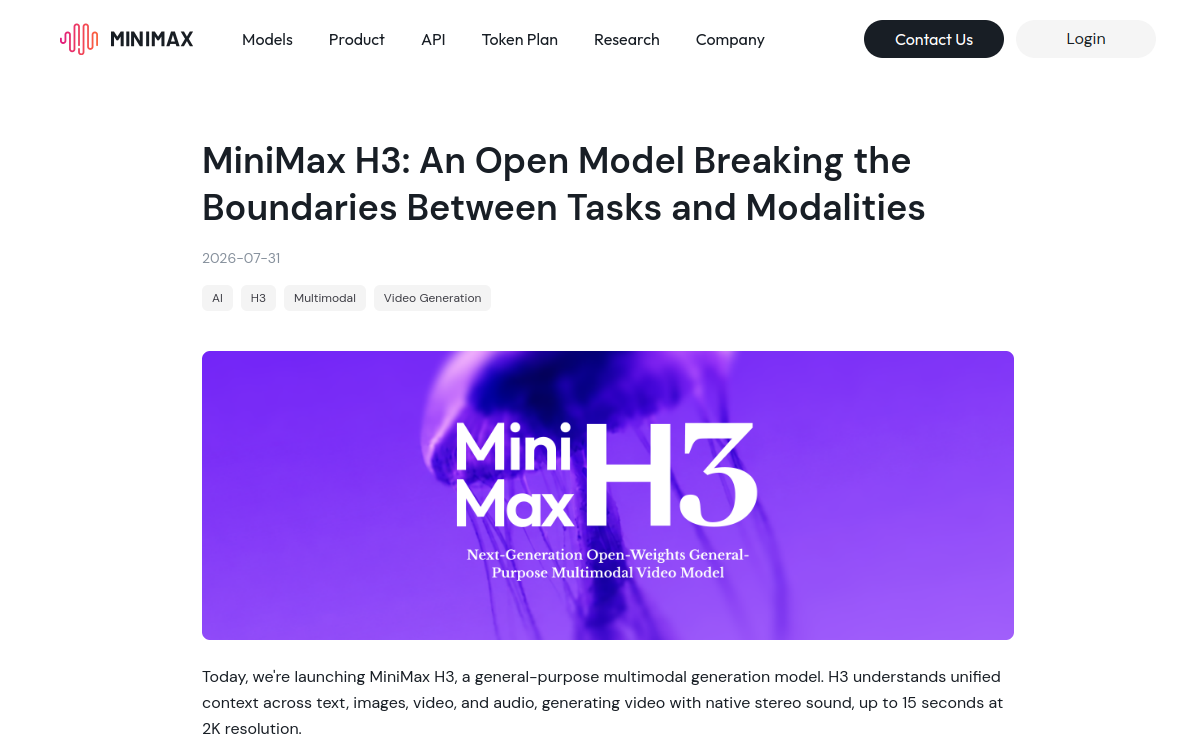
If you follow AI video generation, you have probably come across Hailuo AI without necessarily knowing who was behind it. It is the consumer product of MiniMax, a Chinese company founded in early 2022. On July 31, 2026, it launched H3, the new generation of its model, then published the weights on August 2.
Coverage has mostly latched onto two numbers: 2K and 15 seconds. Both are accurate, and both are the least interesting part of the announcement. What MiniMax describes in its official post is a change in the nature of the model, and an opening of the weights that matters more than the resolution. That opening has happened, and it comes with a restriction almost nobody has picked up: the licence does not cover Europe.
Hailuo AI, MiniMax, H3: which is which?
The confusion is common, and it comes from the fact that the three names refer to three different things that usually appear together.
MiniMax, the company
MiniMax is a Chinese artificial intelligence company founded in early 2022. It does not only do video: it develops a family of models covering text, code, audio, music and images. H3 is its multimodal generation model, M3 its coding model.
Hailuo AI, the product you actually use
Hailuo AI is the consumer application from MiniMax, available in a browser and on mobile. That is where you type a prompt and get a video back. The Hailuo name has also been used for earlier generations of the model, which does not help: the app selector still showed Hailuo 2.3 in early August.
Is H3 already available in the app?
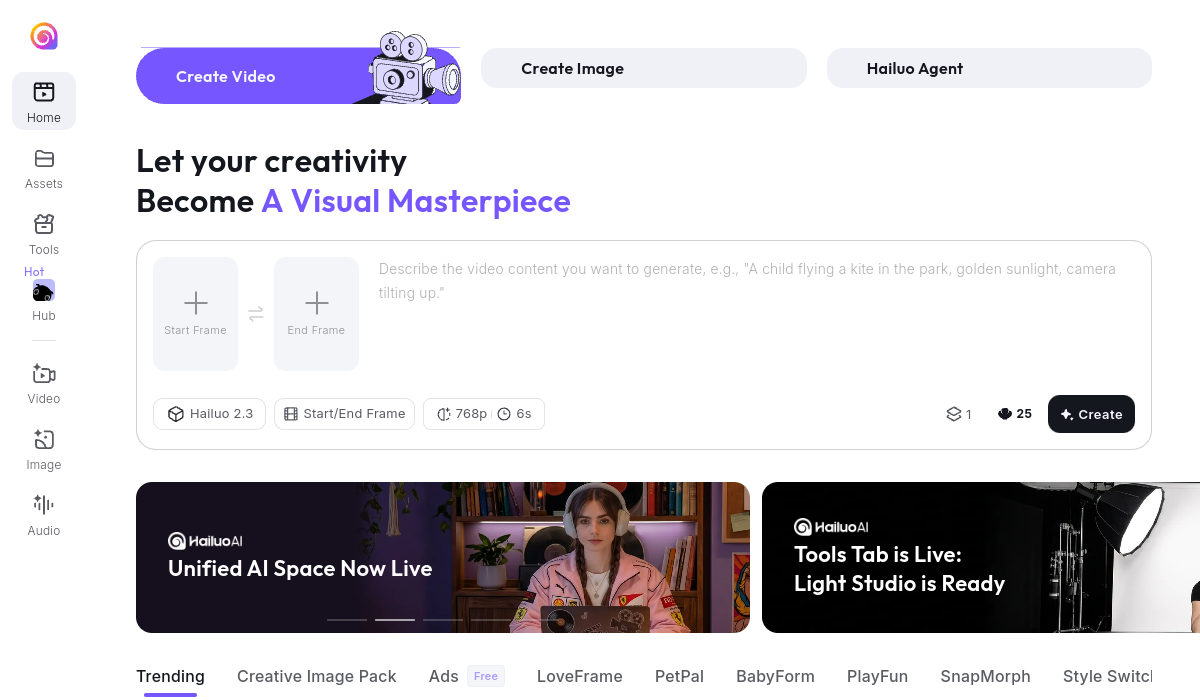
This is the murkiest part of the announcement, and it is worth stating honestly. In its model card, MiniMax lists Hailuo AI and its desktop app as ways to access H3, alongside the API. But on the Hailuo AI home page, the model selector still showed Hailuo 2.3, at 768p and 6 seconds, when we checked on August 1 and again on August 3, 2026. H3 may well be offered in the dropdown once you are signed in: we have no account to verify that, so we are not claiming it.
So do you say Hailuo or MiniMax?
Both, depending on what you mean. To find and use the tool, it is Hailuo AI. To talk about the model, its specifications or its weights, it is MiniMax H3. That duality is why search results constantly mix the two names, often for the same thing.
What MiniMax H3 actually brings
Three things stand out in the official post, and they do not carry equal weight.
Stereo sound generated together with the image
This is the most immediately noticeable point. H3 produces native stereo audio, and more importantly MiniMax states that speech, sound effects and music are no longer handled as separate domains: they are modelled jointly. In practice the model does not paste a soundtrack onto a finished video, it generates both together.
The 2K comes from regeneration, not upscaling
H3 goes up to 2K, for durations of 4 to 15 seconds. The method is worth noting: rather than a classic super-resolution module bolted onto the output, MiniMax has the model regenerate its own low-resolution result while reusing the original context. The vendor explains that this restores small details and fine text, where traditional super-resolution can only guess at them. We come back further down to what the model card says exactly about the default resolution.
Unified multimodal context, the real shift
This is the element press coverage has most neglected. H3 understands a unified context across text, images, video and audio. MiniMax gives a telling prompt example: take the camera movement from a reference video, make the character in an image sing, and match the voice to a supplied audio file. All of it described in natural language, without going through separate specialised tools.
Why that unification matters
Until now, video generation was fragmented into separate tasks: text to video, image to video, first and last frame, subject reference, motion reference, editing. Each task had its own settings and sometimes its own model. MiniMax says it designed H3 to erase those boundaries, using language as the bridge between tasks rather than a menu of fixed modes.
The weights are published, but not for Europe
This is the most consequential part of the whole announcement, and the part to read most carefully. On July 31 MiniMax wrote that it intended to open the model weights in the following days, subject to applicable laws and regulations. That caveat was not boilerplate.
What the opening actually gives you
Video generation has stayed largely closed so far, unlike language models where open weights have become routine. Published weights let you run the model on your own hardware, adapt it to a specific use, and stop depending on per-second billing. MiniMax says it considered hardware compatibility from the earliest design stages.
What the repository actually contains
The model repository is live on Hugging Face, public and accessible with no gating. We counted 297 files there, including 104 weight files in safetensors format split across modules. The model card describes a three-part system: a module that interprets the multimodal instructions and converts them into an intermediate representation, a generation module that outputs at 768p, and a regeneration module that lifts the result to 2K by feeding the original context back in.
The licence excludes the European Union
Here is the element nobody picked up in the coverage. The weights are not under a free licence in the usual sense: they are covered by a bespoke contract, the MiniMax H3 Community License Agreement, dated August 2, 2026. That contract defines an applicable territory, and it defines it as worldwide with four exceptions: the European Union, the United Kingdom, South Korea and the United States of America.
What that rules out from an excluded territory
The licence grants the right to use, reproduce, modify and distribute the model solely within the applicable territory. A dedicated clause states that use, reproduction, modification, distribution and display of the model, as well as of its outputs and results, are not authorised outside that territory. The list of prohibited uses that closes the contract in fact begins with use outside the applicable territory.
- Downloading from the EU, UK or US: technically possible, the repository is public and unrestricted.
- Running the model there: not authorised by this licence, since those are excluded territories.
- Using the videos you produce: the restriction explicitly covers the outputs of the model, not only the weights.
- The route the vendor provides: MiniMax says it is continuously evaluating the requirements of the excluded territories and invites interested parties to contact it for a suitable licence.
Why the exclusion, and what we cannot claim
MiniMax gives no detailed reason: the contract refers to continuous evaluation of the laws, regulations and compliance requirements of those territories. One calendar fact can be noted without inferring intent: the licence is dated August 2, 2026, the very day the transparency and labelling obligations for AI-generated content took effect in the European Union. The four excluded zones are also those where AI regulation is furthest along. That is a plausible reading, not a statement from the vendor, and we present it as such.
The other conditions worth knowing
Two clauses deserve attention from anyone considering professional use inside the permitted territory. Prior written authorisation from MiniMax is required if the commercial products or services involved generate more than twenty million US dollars in yearly revenue. And any commercial product built on H3 must display the MiniMax H3 name prominently in its interface.
Open weights does not mean open source
The distinction is useful for reading announcements in this market. Open weights means the model files are downloadable and runnable. An open source licence, in the established sense, imposes no territorial restriction, no restriction on field of use and no revenue threshold. H3 falls into the first category and not the second, like most so-called open models released by the major vendors.
The exact specifications, from the model card
Publishing the weights has a useful side effect: the model card is far more precise than the announcement post, and it corrects a widespread shortcut along the way.
| Specification | Value stated by MiniMax |
|---|---|
| Output duration | 4 to 15 seconds |
| Resolution | Shorter side at 768 pixels by default. 2K is obtained through a dedicated regeneration module |
| Frame rate | 24 frames per second |
| Audio | Stereo, 32 kHz |
| Aspect ratios | 21:9, 16:9, 4:3, 1:1, 3:4, 9:16 and others |
| Dialogue languages | 11 languages with stable support, including English |
| Reference-mode inputs | Up to 9 images, 3 video clips and 3 audio clips, 12 files in total |
2K is not really the default setting
The announcement post says MiniMax offers 2K by default, which holds for its online service. The model card is more nuanced: the shorter side is 768 pixels by default, and 2K goes through a separate regeneration module. The nuance matters if you plan to run the model yourself, since 2K then requires an extra compute step.
English is among the supported languages
The model card lists eleven languages with stable support for dialogue, and English is one of them, alongside Arabic, Chinese, French, German, Italian, Japanese, Korean, Portuguese, Russian and Spanish. That is concrete information for English-language use, with the caveat that the licence does not cover the United Kingdom or the United States.
What does H3 cost?
This is where clarity matters most, because several figures are circulating without the same standing.
What MiniMax states officially
The vendor publishes no absolute price in its post. It gives a ratio: at 2K, the per-second price of H3 would be less than a third of that of mainstream models, and at 768p less than half the price of mainstream models at 720p. It is a relative comparison, without naming the reference models.
The 1.95 dollar figure going around
Several outlets have put forward a price of around 1.95 dollars for 15 seconds at 2K. That figure does not appear in the official MiniMax post. It may well be accurate, but it comes from the press and not from the vendor: until it is confirmed on a public price list, we mention it without adopting it as our own.
What you actually pay
On Hailuo AI, billing runs on a credit system, and the real cost of a generation depends on resolution, duration and the plan you are on. It is the same trap as with most competitors: the advertised subscription price tells you nothing about how many videos you will actually be able to produce.
H3 against Sora, Veo and Kling
Here is how H3 sits on publicly announced specifications as of August 3, 2026. This table compares vendor claims, not measured results.
| Model | Announced resolution | Audio | Open weights |
|---|---|---|---|
| MiniMax H3 | 768p by default, 2K by regeneration, 4 to 15 s | Native 32 kHz stereo, generated with the image | Published August 2, 2026, licence excluding the EU |
| Sora 2 | See our dedicated article | Yes | No |
| Veo 3 | See our dedicated article | Yes | No |
| Kling 3.0 | See our dedicated article | Yes | No |
What this table does not tell you
Nothing about output quality, motion coherence or prompt fidelity. Those criteria cannot be read off a spec sheet and we have not run a comparative test. On that ground, only trying it on your own prompts really settles anything.
H3's real differentiator
It is the open weights that set H3 apart from the rest of the market, far more than the resolution. None of the other three models is available as open weights, and none is likely to be any time soon. The caveat is that this opening, as licensed, is not aimed at European, British or American users.
How to access it today
Two routes, depending on whether you just want to try it or to integrate the model into a production pipeline.
Through Hailuo AI, to try it
The app runs in a browser. The prompt field lets you pick the model, the resolution and the duration before launching a generation, and shows the credit cost of the operation. It is the simplest way to form an opinion.
Is the interface in English?
The app is used in English in its main version. That changes nothing about how you write your prompts: models of this generation handle English without difficulty, and the documentation and interface labels are mostly in English already.
Can you test it without paying?
You need to create an account, and the service runs on credits. The number of credits granted at sign-up and the per-generation rate change regularly, including during promotional pushes: we would rather not pin down a figure here that would be wrong in two weeks. Check the balance shown in the interface before launching a batch, the cost climbs fast at 2K.
Through the API, to integrate
MiniMax exposes its models through an API, which remains the normal route for volume use, and the only lawful route from an excluded territory given the current state of the weights licence. A third route now exists elsewhere in the world: local execution, with no per-second billing.
What to watch from here
Two things. First how the licence evolves: MiniMax says it is continuously evaluating the requirements of the excluded territories, so a revision that opens up Europe is possible without being promised. Then the full technical report, which the vendor says it intends to share shortly and which will allow its architecture claims to be checked against measurements.
MiniMax H3: the weights are open, but the licence excludes the EU, UK and US
H3 is a more interesting announcement than its two most repeated numbers suggest. The 2K and the 15 seconds are the market catching up, not a break. The break rests on two things: a model that handles text, images, video and audio in one shared context instead of stacking specialised tools, and weights genuinely published on ground that had stayed closed.
That said, for a reader in the EU, the UK or the US, this opening is largely symbolic. The licence excludes those territories, and it excludes even the outputs of the model: from there, the lawful route still runs through the API or through a licence negotiated with the vendor. On price, finally, the 1.95 dollar figure circulating in the press does not come from MiniMax, which confines itself to a relative ratio with no absolute number. We will update this article if the licence changes.
Frequently asked questions
Are Hailuo AI and MiniMax H3 the same thing?
No. MiniMax is the company, Hailuo AI the consumer app, and H3 the model announced on July 31, 2026. MiniMax presents Hailuo AI as a way to access H3, but the app model selector still showed Hailuo 2.3 on August 3, 2026: we cannot confirm that H3 is already served there by default.
Is Hailuo AI free?
Access runs on a credit system. The cost of a generation depends on resolution, duration and plan. As with most competitors, the advertised subscription price alone does not tell you how many videos you will be able to produce: it is the credit rate that matters.
What is the maximum video length with H3?
From 4 to 15 seconds according to the model card published by MiniMax. The shorter side of the image is 768 pixels by default, with 2K obtained through a dedicated regeneration module.
Does H3 really generate sound along with the video?
Yes, according to MiniMax. The audio is native stereo, and speech, sound effects and music are modelled jointly rather than treated as separate domains. So the sound is not added afterwards to an already generated video.
Are the MiniMax H3 weights downloadable?
Yes, since August 2, 2026. The model's Hugging Face repository is public and accessible with no gating. One caveat: the licence that comes with them defines an applicable territory that excludes the European Union, the United Kingdom, South Korea and the United States. From those territories the download is technically possible but the use is not authorised by this licence.
How much does a 2K generation with H3 cost?
MiniMax publishes no absolute price. The vendor states only that at 2K its per-second price is less than a third of that of mainstream models. The figure of around 1.95 dollars for 15 seconds comes from the press, not from MiniMax.
Can MiniMax H3 be used in the EU, the UK or the US?
Through the Hailuo AI app and the MiniMax API, yes. The weights published on August 2, 2026 are however covered by a licence whose applicable territory excludes those countries: running the model locally there is not authorised by that contract, which extends the restriction even to the outputs of the model. MiniMax invites parties located in those territories to contact it for a suitable licence.
Is MiniMax H3 open source?
No, it is an open-weights model, which is not the same thing. The files are downloadable, but the licence is a bespoke contract that restricts the territory of use, requires the MiniMax H3 name to be displayed in commercial products, and demands written authorisation beyond twenty million dollars in yearly revenue. An open source licence in the established sense imposes none of these conditions.
Does H3 understand English?
Yes. The model card lists eleven languages with stable support for dialogue, and English is one of them, along with Arabic, Chinese, French, German, Italian, Japanese, Korean, Portuguese, Russian and Spanish.